Storytelling, the Unconscious, and the Subconscious Minds
The unconscious is where we store memories. To help compact this storage of a huge volume of memories, feelings are shorn from each memory. Scientists have discovered that when people retrieve memories, they can be guided to attach different feelings to them than those that were originally experienced.

The unconscious is also where fixed ideas about who we are and what we think about our place and role in the world are embedded. Think of ideas buried there broadcasting a message, like a radio transmitter. 24/7. You might think of yourself worthy, but buried in your unconscious could be the message that you are not. Or any powerful message that drives your conscious feelings and awareness.
The conscious mind is, in most people, consumed by measuring and weighing things. Our relationships, our standing compared to others, how we judge and measure ourselves compared to others. In most people, a significant part of the conscious mind is engrossed in these issues.
Narrative tension in a story is the tension a character feels about something they seek to gain, achieve, or, in some cases, avenge. It can be the tension a character experiences from a change in circumstance that changes their standing and relationships or a change in a character's internal sense of who they are.
In life, we experience narrative tension about the 'story' of our life, and whether what we seek is within our grasp. Our narrative tension can also revolve around our desire to escape something we feel is imposed on us, whether by fate or our choices.
We also experience narrative tension when our conscious story of who we are is in conflict with an unconscious story of who we are.
An example, a nun told a story about two women. When they were young, the mother constantly referred to one daughter as the 'pretty one' and the other daughter as the 'smart one.' The 'pretty one' grew up to be a lawyer who worked at the United Nations. No matter what she accomplished, inwardly she felt stupid.
The 'smart one' grew up to be an attractive young woman who, no matter what compliments she received about her looks, felt ugly inside.
In each case, they experienced narrative tension over the internalized story idea of who they were, opposed to external validation.
I heard one aware person refer to these kind of people as hungry ghosts.
When I read novel manuscripts written by struggling writers, I can tell with a certainty what they are ashamed of, who they blame for their situation in life, and what fuels the rage that burns within them. What the main character in their novel wants, that I have to guess.
Bringing this back to writing, struggling writers who unintentionally go into their unconscious to write (watch the movie created from memories, write down the details) tend to write visual information shorn of emotional content. It moves the writer because he or she attaches emotion to the events or people described, but the writing doesn't generate that effect for a reader.
Writers who have internalized an understanding of storytelling can use their subconscious to develop insight into the narrative tension of their characters. Think of the subconscious as like the engine room in a 40's film. The captain gives an order, which someone relays to the engine room, and power is made available to turn the ship in a specific direction or speed up or slow down. But the Captain never has to go down to the engine room to get that result.
One accepted idea about storytelling is that many successful writers are intuitive about creating stories. Brain scans have shown that what people often consider to be intuitive thoughts are just as often the subconscious floating ideas up into the conscious mind.
That requires that a writer have internalized an understanding of storytelling the subconscious can work with. That's the problem for most struggling writers. I often find that new writers are blind imitators. They can quote people like Stephen King's book On Writing, but their own writing is lacking.
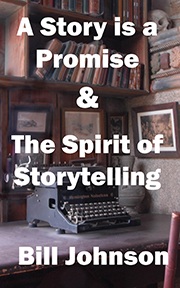
A solution to this is for the struggling writer to gain and internalize an understanding of storytelling. This means being consciously aware of the mechanics of how to tell a story, the techniques that I cover in A Story is a Promise (and that others have covered in their own way).
The reason even this pathway will fail for many struggling writers is they have no real interest in telling a story to an audience; they are really telling a story to themselves to deal with their internal narrative tension. When the fuel for that burns out, they move on to doing something else that helps them balance their narrative tension.
Instead of learning the craft of storytelling, some writers blame their lack of intuitive storytelling ability or credit the success of other writers to their intuitive sense.
When a writer confuses their narrative tension with the narrative tension of a novel's main character, they can fail to recognize why a story character isn't coming to life and what to do about it.
I've written in another essay about how getting to the subconscious can be a pathway to the superconscious, and a deeper ability to understand a story character's narrative tension. I believe that when writers are in what is called a creative flow, their subconscious is actively generating new ideas and insights into their story, characters and plot, this rises to conscious thought, which sparks new ideas that in turn generates a strong flow of subconscious and conscious ideas for a story.
One of the pleasures of deep meditation is a sense that different aspects of the brain (left hemisphere, conscious/subconscious/unconscious) experience a clarity and unity. All the doors in the house open, so to speak.
That makes creating a story a pleasure to experience.
To read more of my essays on the craft of storytelling, visit https://www.storyispromise.com
Check out Bill's writing workbook, A Story is a Promise, available on Amazon Kindle. A Story is a Promise explains the mechanics: what you set up, you owe the reader. Spirit of Storytelling explains what fills that promise: a character with a life of their own, not a stand-in for the author. Read together, they cover both halves of what makes a story work — the structure and what it's structured to carry.


Comments
Post a Comment